Showing posts with label The Doctor Is In. Show all posts

Wednesday, May 4, 2011

The Doctor is In! - Take Your Burden To the Lord

Take Your Burden To the Lord and Leave It There
       My brother Brandon holds degrees in engineering from the University of Michigan and recently sent me an email about computer engineering. It said that the software engineers who understand how the computer works are called homo logicus. The typical user, like me, is unconcerned about the inner workings of the computer. As long as it makes my work more efficient I don’t need to know HOW such things as “copying,” “cutting,” “pasting,” “deleting,” etc. work. It’s only a problem when, for whatever reason, my computer stops working properly.
       To alleviate my pain as user and eliminate the disconnect between me and homo logicus, another set of people is needed to bridge the gap. These engineers need skills not only in observing human behavior and creating human-centered designs, but also of empathy, sympathy, and compassion. At Menlo Innovations they give these engineers a special name: High-Tech Anthropologists
       What a perfect metaphor for my relationship with God! He is the homo logicus who understands how I work inside and out. This is a “logical” (logicus) assumption since God created man. Since His power is absolute and His wisdom infinite, He knows exactly what makes me tick. But when man sinned, he became alienated from the Creator and needed a high-tech anthropologist to bridge the gap; someone who could have empathy, sympathy, and compassion.
       Enter God’s Son Jesus the God-man! He left His throne in glory to become human like me; to bridge the lacuna. One of my favorite writers says that while on earth “Jesus calmed angry waves, walked on foam-capped billows, made demons tremble and disease flee, opened blind eyes and called forth the dead to life. And as the sin-bearer He endured the wrath of divine justice and for my sake became sin itself.” In other words, Jesus is my high-tech anthropologist! Hallelujah!
       And he continues to bridge the gap for me. For the apostle Paul said, “For we do not have a High Priest who cannot sympathize with our weaknesses, but was in all points tempted as we are, yet without sin.” Heb. 4:15


One of the verses from a Charles Tindley hymn also resonates:
If your body suffers pain and your health you can’t regain
And your soul is almost sinking in despair,
Jesus knows the pain you feel, He can save and He can heal;
Take your burden to the Lord and leave it there.


Cedric Dent is a baritone vocalist in Take 6 and an accomplished producer and music arranger. Dr. Dent is a professor of Music at Middle Tennessee State University. He studied at the University of Michigan (B.M., Vocal Music Education), University of Alabama (M.M., Music Theory/Arranging), and the University of Maryland (Ph.D., Music Theory).


Official Site  |  Like Us  |  Follow Us

Wednesday, April 20, 2011

The Doctor is In! - Inspirations, Pt. 2

Inspirations, Pt. 2


Here is the second and final installment (for now) of just some of the great artists who inspire me. I’ll revisit this topic in the future since there are so many that have inspired me.

Kirk Whalum

Whenever I’m in Kirk’s presence I sense that he has just been with God. He is one of my favorite sax players and one of the most sincere Christians that I know. It comes through in his music whether he’s playing religious or secular music. I once shared an appearance with Kirk at an elementary school’s career day in Nashville, TN. He performed, talked, and read scripture to the kids. Along the way he mentioned that though he’s an accomplished musician, he still practices his horn several hours a day because he wants to be sure that he’s always giving God his best. He’s anointed!

Jason Max Ferdinand
I’m inspired by Jason’s work ethic. Among other roles, he is the director of the legendary Oakwood University Aeolians! I’ve watched him conduct a two-hour choral performance with no sheet music in front of him and never missing a cue. He does his homework! I’ll be directing the vocal jazz ensemble at MTSU this fall. Since this will be my first time directing a student ensemble, I asked Jason for some conducting advice. Specifically, I asked, “how much music should I anticipate teaching in the first semester”? His answer says a lot about his dedication to preparation. He offered more than one approach. One way is to add up the number of minutes of rehearsal time for the entire semester and divide the total by the approximate time that it might take to learn one piece of music. That will yield the approximate number of pieces that the choir will be able to learn in a given semester. Whew! I love the way he thinks!

Russell Ferrante
As a pianist myself, how could I not be inspired by this innately gifted keyboardist and jazz composer/arranger? He is a founding member of the Yellowjackets—the modern jazz quartet of the 21st century! And like everyone else on this list, he is always well prepared for the musical task at hand. As an example, he, along with David Thomas and myself, co-arranged “God Rest Ye Merry Gentlemen” on TAKE 6’s first Christmas recording, “He Is Christmas” (released in 1991). I will never forget him saying at the recording session that in preparation for the musical arrangement and recording session, he listened to 20 – 25 different recordings of “God Rest Ye Merry Gentlemen.” Impressive to say the least!

David Foster
David is one of the most intuitive musicians I’ve worked with. I had the honor of co-writing with David for TAKE 6’s “Join the Band” CD (released in 1994). To say that I learned a lot from this genius is an understatement. I learned so much about composing, arranging, recording, and mixing a pop tune. But what inspires me most about David is how acutely aware he is of his strengths and weaknesses as a musician. His transparency in this area only adds to his greatness. He is one of the most gifted composers of the popular ballad. But ask him to pen a blistering up-tempo dance tune, and he is quick to tell you that that is not his thing. Seeing this quality in David was liberating for me. I’m now more comfortable in accepting my own weaknesses while maintaining a positive self-image. Thank you David!

Cedric Dent is a baritone vocalist in Take 6 and an accomplished producer and music arranger. Dr. Dent is a professor of Music at Middle Tennessee State University. He studied at the University of Michigan (B.M., Vocal Music Education), University of Alabama (M.M., Music Theory/Arranging), and the University of Maryland (Ph.D., Music Theory).

Official Site | Like Us | Follow Us


Wednesday, April 13, 2011

The Doctor is In! - Inspirations, Part 1

Inspirations, Pt. 1


While I’ve been inspired by the work of countless artists, there are some with whom I’ve had direct contact and who have affected me profoundly. Following is the first part of a list of artists I find inspiring, some with whom I have a personal relationship.


Quincy Jones
Q is possibly the most successful music producer of the 20th century! Best known for producing Michael Jackson’s biggest selling albums, Q has done it all, from being a jazz musician to scoring dozens of films and TV show themes to producing great studio recordings. TAKE 6 has worked with him on numerous occasions. He has a special way of making artists feel comfortable in the recording studio. I am particularly inspired by the way he can spend two hours just shooting the breeze and then record for 30 minutes and get the best performance out of his artists. He also has a gift for recognizing a great song and, consequently, treats good songwriters like gold.


Marcus Miller
… is one of the greatest electric bass players alive and an awe-inspiring jazz composer/arranger. He’s also a wonderful producer who produced TAKE 6’s “A Beautiful World” CD (released in 2002). And like Q, he is great at putting the artist at ease and getting the very best recorded performance. Marcus is also a great storyteller and very affirming. Often, when there is a lull in the studio, or after we haven’t seen each other for a while, he’ll ask me to go to the piano and play one of my arrangements of a hymn or spiritual. Musicians become better musicians as a result of working with Marcus. And that, of course, is the mark of true greatness.


Alvin Chea
He has to be the hardest working bass vocalist in the biz. He’s certainly the best that I know! I admire how Vinnie dreams big and works tirelessly. And he’s great at multitasking. I recently heard him say he does a minimum of two recording sessions for film soundtracks every month. He’s also a published author, an accomplishment to which I aspire. Honestly, I don’t know how he keeps so many balls in the air. It is an honor to sing regularly with such a rare talent, and he inspires me!


JimEd Norman
JimEd is the former head of the country music division of Warner Brothers Records, and the visionary who signed TAKE 6 to our first professional recording contract in 1987. Like Q, JimEd is a “song man.” But what I really admire about him is his sage advice on career matters and life in general. He introduced TAKE 6 to the term “regression to the mean.” It’s another way of describing the art of compromise—a necessary characteristic of bands that get along and stay together.


Cedric Dent is a baritone vocalist in Take 6 and an accomplished producer and music arranger. Dr. Dent is a professor of Music at Middle Tennessee State University. He studied at the University of Michigan (B.M., Vocal Music Education), University of Alabama (M.M., Music Theory/Arranging), and the University of Maryland (Ph.D., Music Theory).

www.take6.com | www.facebook.com/take6

Wednesday, April 6, 2011

The Doctor is In! - Music Arranging

Music Arranging: Vocation or Avocation?

TAKE 6 recently performed two shows in Bogota, Colombia. It was our first time to the country and, honestly, I was not impressed initially. It was overcast for most of the time we were there, and I learned that it rains most of the year. This is due to Colombia’s high elevation—8661 ft. above sea level. The altitude wreaks havoc on the breath control of singers not accustomed to the thinner air. The temperature is normally in the 60s year-round with no change of seasons (never getting cold enough to snow or hot enough to lie on the beach).

But on the other hand, Colombia is surrounded by mountains which make for some breathtaking views. Trees and vegetation are green year-round, and flowers are always blooming. In fact, the reason we in the US are able to buy roses year-round is because of places like Colombia. And the people are warm and inviting!
My initial thoughts about Colombia are akin to the way the craft of music arranging is often viewed. It’s underrated and under-valued inside and outside of the music industry. Most lay persons don’t know what the term “music arranging” means, let alone the fact that it is a specialized field in the industry. Heck, I have a degree in the field and there are categories of Grammy Awards designated specifically for MUSIC ARRANGING! I’m proud to say that my work has been nominated twice in these categories. I also teach a course devoted to the craft of music arranging at MTSU.
While songwriters, music producers, music publishers, and recording artists receive royalties, arrangers do not. Arrangers get paid a onetime fee for their work if they get paid at all. And I’m often asked to provide vocal, rhythm, horn, or orchestral arrangements for no fee.
So why do I bother? Because I can’t help myself. It’s a God-given ability and I love doing it! And I realize that while I could get paid more by concentrating on other facets of the music industry, ultimately I would not be as fulfilled. I MUST arrange music and teach this skill to others because it’s just the way that I’m wired. I often tell my students to choose a vocation because you love it, because it completes you; not for the money you can earn. And if you are truly passionate about it you are destined to be exceptional at it. And if you are exceptional at something, you are destined to be paid handsomely for it sooner or later. I’m a living witness! At the end of TAKE 6’s stay in Colombia, I had fallen in love with the country. And at the end of the day, music arranging is my passion—my vocation!
Cedric Dent is a baritone vocalist in Take 6 and an accomplished producer and music arranger. Dr. Dent is a professor of Music at Middle Tennessee State University. He studied at the University of Michigan (B.M., Vocal Music Education), University of Alabama (M.M., Music Theory/Arranging), and the University of Maryland (Ph.D., Music Theory).
www.take6.com | www.facebook.com/take6

Wednesday, March 30, 2011

The Doctor is In! - Doing the Impossible

Doing the Impossible

Speaking of his two passions, Francis Ford Coppola once said, “When someone makes a great wine or a great film he has done the impossible.” He should know. He directed one of my all-time favorite film franchises—“The Godfather.”
Think about it. In a single film, there are so many elements that have to be done well and work well together for it to become a great work of art. There is production, direction, casting, acting, the screenplay, film editing, sound editing, lighting, special effects, incidental music, songs, music editing, marketing, and the timing of the film’s release just to name a few. Even when every element is done perfectly, a film can turn out mediocre. How many times have you felt that a great actor was placed in the wrong role, or the story worked better as a novel? Or perhaps there’s a song, wonderful on its own merit, but doesn’t work in the film. 
Because the process is so vast and perhaps quixotic, there is one element that is critical for a film, or any work of art for that matter, to be better than good, reach the sublime, or achieve the impossible. It is that intangible thing that cannot be learned, acquired or controlled. It’s called SERENDIPITY or DIVINE PROVIDENCE! You may recall my description of this quality in a previous blog.
On a smaller scale, the same process is at work in creating a great song. Everyone has had the experience of wondering why a great song didn’t become a hit. A wonderful example of serendipity at work is the success of the song “I Will Always Love You.” Written and recorded several times by Dolly Parton, this song reached number 1 on the Billboard Hot Country Songs chart twice—once in 1974 and again in 1982. Both recordings had modest success on the pop charts. Then Whitney Houston recorded it in 1992 for the soundtrack to the movie, “The Bodyguard,” starring Houston and Kevin Costner. It became one of the best-selling singles of all time, selling over 12 million copies worldwide! Dolly Parton’s earlier successes had already demonstrated the song’s viability. What made the difference in Whitney Houston’s version? Consider too that Whitney’s rendition begins a cappella, which is unconventional for pop radio and was discouraged by her record label. I submit that it was the serendipitous coming together of several elements—a great song, Whitney’s phenomenal vocal performance, a great musical arrangement, tasteful production, the association with a hit film, and the perfect timing of the film’s release as well as the single—that conspired to do the impossible.
I understand this phenomenon from another perspective when I look at the longevity of TAKE 6. It’s clear to me that when TAKE 6’s current line-up came together in 1991 that God had done the impossible. Alvin, our bass singer, once said that it was the “coming together of the tribal chiefs.” Most, if not all, of us led vocal groups of our own before joining TAKE 6. Our singing inspires my vocal arranging and then often exceeds the expectations that I have for my arrangements. Handpicked by God, the whole is significantly more than the sum of its parts. Because with God, all things are possible (Matt. 19:26).
Cedric Dent is a baritone vocalist in Take 6 and an accomplished producer and music arranger. Dr. Dent is a professor of Music at Middle Tennessee State University. He studied at the University of Michigan (B.M., Vocal Music Education), University of Alabama (M.M., Music Theory/Arranging), and the University of Maryland (Ph.D., Music Theory).


Wednesday, March 23, 2011

The Doctor Is In! - I'll Never Turn Back No More

I’ll Never Turn Back No More

The first decisions that should be made when beginning a vocal arrangement should deal with the big picture. This includes deciding the key of the arrangement based on the range of the voice parts. Whether the arrangement will feature a lead with background voice parts (e.g., “A Few More Miles”), or be primarily homophonic—all voice parts singing lyrics together without a lead singer (e.g., “Family of Love”)—is another big picture decision. Only after consideration of such broad characteristics should the arranger focus on more detailed elements like harmonization and phrasing.

Similarly, when transcribing or analyzing an arrangement for didactic purposes, one should begin with broad characteristics, the first of which is the form of the song and its musical arrangement. Bear in mind that the form of a song and the form of an arrangement of that same song may be different, particularly if it’s an arrangement of a commonly performed song (e.g., Christmas Carols or Beatles’ tunes).
The original melody of the spiritual “I’ll Never Turn Back No More” is comprised of three 8-bar phrases. The second phrase is a repeat of the first; the third phrase introduces a contrasting melody. Accordingly, the form of the melody can be represented by the letter scheme AA’B. Each letter represents an 8-bar phrase. The first two letters are the same indicating that the melody of the first phrase repeats in the second phrase. The melody as performed by TAKE 6 is presented below. Notice that the second phrase (bars 9–16) is not an exact repetition of the first. However, it is recognizable as a varied form of the first phrase. For this reason the second phrase has been marked as A’. The added tally mark indicates that the repetition is not exact.
On closer inspection, notice that the second part of all 3 phrases is essentially the same (i.e., bars 5–8, 13–16, and 21–24). Accordingly, a diagram of the form of “I’ll Never Turn Back No More” as performed by TAKE 6 is presented below. In the diagram there is an uppercase letter for each 8-bar phrase in the song. Subphrases are represented by lowercase letters. Notice that the second subphrase within each phrase is the same (b).
Returning to the melody in the diagram above, notice that the apex of the melody, and consequently the climax of this beautiful spiritual, occurs when the high “D” is reached in bar 17. This sense of climax is heightened by a lengthening of the bar just before the climax. The lengthening of bar 16 effectively delays the arrival of the climax, a delay that creates a sense of anticipation thereby intensifying the effect of the climax. Additionally, the contrasting melody of the third phrase, which contains the climax, adds to the heightened tension at this point in the spiritual.
Two arranging techniques were employed to compliment the structure of the melody. First, listen to TAKE 6’s performance of this piece (from our “Feels Good” CD), focusing on the use of syllables that are employed throughout. Phrases 1 and 2 are sung using an “ooh” vowel sound. The beginning of phrase 3, where the climax occurs, uses an “ah” vowel sound. “Ah” is a naturally louder vowel sound than “ooh.” In fact, it is the loudest vowel sound used in the performance and is reserved for the climax. Notice, too, that the voice parts of bar 16, where the meter briefly changes to quadruple time, utilizes an “oh” vowel sound. This sound is louder than the preceding “ooh” but softer than the “ah.” It is, in effect, a transitional sound that compliments the build up to the climax in bar 17.
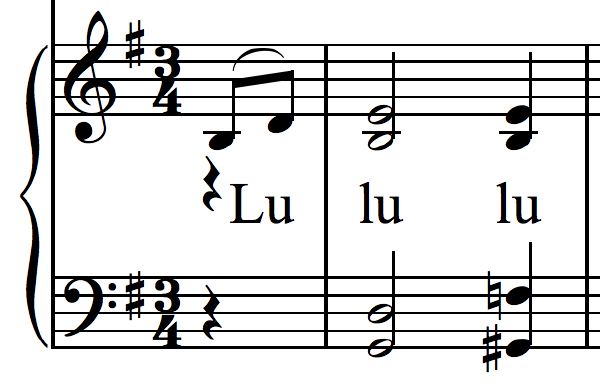
The second arranging technique that compliments the structure of the melody has to do with the relative thickness of the vocal texture (i.e., the number of notes per chord). Phrase 1 employs a 4-part texture. The example below shows the texture of bar 1 from the opening phrase.
To enhance the build up to the climax in bar 17, note how the vocal texture expands at the end of phrase 2 from a 4-part texture in bar 15 to a 5-part texture at the beginning of bar 16. The texture further expands to a 6-part texture within bar 16 in preparation for the climax in bar 17. Finally, the dynamic markings show a build up to the climax, swelling to a forte marking in bar 17. 
This combination of techniques to effect the climax of the performance is shown in the following example where the guitar part is on the uppermost staff and the voice parts on the lower two staves.
There’s a lot more that could be addressed in this arrangement such as reharmonization techniques, including the effective use of a deceptive progression in bars 14–15, the variety created by the arpeggiated bass line in phrase 2, and how the last subphrase (bars 21–24) returns to the 4-part texture of the opening, effectively creating an arch-like structure in the form of the musical arrangement.

Transcribing music from recordings is the best way to internalize effective music arranging techniques. The analytical observations discussed in this blog, beginning with the form of a song and its musical arrangement, are part of the transcription process, a process that I regularly use to sharpen my arranging skills.


Cedric Dent is a baritone vocalist in Take 6 and an accomplished producer and music arranger. Dr. Dent is a professor of Music at Middle Tennessee State University. He studied at the University of Michigan (B.M., Vocal Music Education), University of Alabama (M.M., Music Theory/Arranging), and the University of Maryland (Ph.D., Music Theory).